
A Calculated Risk: Tesla Unleashes RoboTaxis Ahead of Crucial Earnings Call
Now, a new era begins—or so we are told. Today, Tesla has launched its fully unsupervised Robotaxi service in Austin, Texas. The safety monitor is gone. Members of the public can now use an app to hail a car and be driven by the company’s Full Self-Driving (FSD) software, with no human employee present to intervene. The wheel provides no control, if a passenger grabs the steering wheel a message asks them to stop, and the car will eventually pull over if the interference continues. The passenger's dominion extends only to the media screen. This is no longer a test—it is a commercial product offered to the general public.
The technological leap is undeniable, a testament to relentless engineering. Yet we must look beyond the spectacle and ask the reasonable, necessary questions. Why this aggressive push now? And on whose terms is this future being built? The most immediate question revolves around safety. According to a December 2025 report from Electrek, which has tracked mandatory National Highway Traffic Safety Administration (NHTSA) filings, Tesla’s Robotaxi fleet in Austin has been involved in at least eight reported crashes between July 2025 and October 2025. The data, though partially redacted by Tesla, shows incidents involving other cars, cyclists, fixed objects, and an animal. Crucially, all these collisions occurred with a trained human safety supervisor present in the vehicle, tasked with preventing such events.
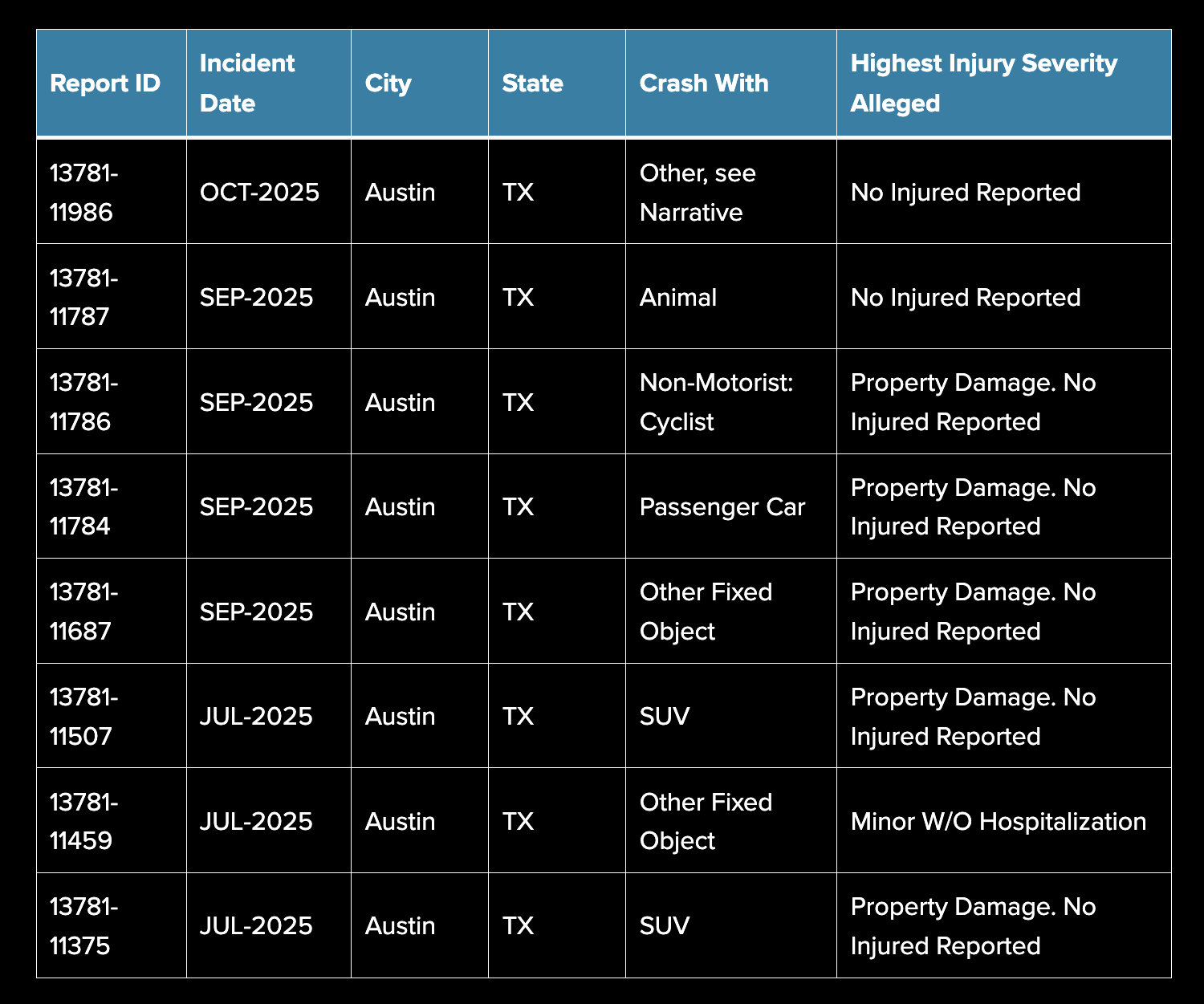
The math is sobering. With roughly 250,000 miles driven, the fleet was crashing approximately once every 40,000 miles. The average American driver has a crash about once every 500,000 miles. This means Tesla's system, even with a human backup, was crashing over ten times more frequently than a human driver. The logical and urgent question follows: if the system fails this often with a supervisor, what is the projected failure rate without one? Tesla’s answer, effectively, is to remove the supervisor and find out in real-time, with the public as participants.
This brings us to the second, glaring question of timing. This landmark launch comes just six days before Tesla’s ($TSLA) critical Q4 2026 earnings call. For years, CEO Elon Musk has staked the company’s astronomical valuation on the promise of a fully autonomous future. The Robotaxi network is not merely a product line; it is the central pillar of Tesla’s growth narrative to investors. Launching the first public-facing, unsupervised service directly before a quarterly earnings call is a powerful market signal. It transforms a technical milestone into a financial statement, applying maximum pressure to a stock that has long been priced for perfection.
We must ask: Is this launch primarily driven by technological readiness, or by market necessity? Is the public road the proper venue to close a safety gap of such magnitude, or is this an experiment that places operational and reputational risk onto city streets and their inhabitants? The people of Austin are no longer just residents; they are beta testers in a live environment, their safety part of the data set that will either validate or undermine a trillion-dollar corporate vision.
True innovation marries ambition with responsibility. It does not silence difficult questions with the dazzle of new technology. As this service rolls out, regulators, local officials, and the community itself must demand transparency. What is the specific safety benchmark Tesla must meet before expanding? How will crash data for unsupervised vehicles be reported and disclosed, given the company’s history of redacting key details in NHTSA reports?
The arrival of the driverless car is a historic turning point. But progress cannot be measured solely in miles traveled without a steering wheel. It must also be measured in lives protected, in trust earned, and in the unwavering priority placed on public welfare over stock price. The future is here, but it is our collective duty to ensure it is built on a foundation of safety, not just speed.
HOME | NATIONAL | HEALTH / LIFESTYLE | FINANCE | SPORTS | TECH | MUSIC / ENTERTAINMENT | OPINION