
Breach at the Door: ICE Memo Greenlights Warrantless Home Entries
A newly leaked directive from U.S. Immigration and Customs Enforcement (ICE) has ignited a firestorm of legal and moral outrage, signaling a profound shift in domestic enforcement tactics. Signed by Acting ICE Director Todd Lyons, the memo instructs officers to use Form I-205—an administrative warrant filled out and authorized by ICE itself—to enter private homes between 6 a.m. and 10 p.m. to arrest individuals with final orders of deportation.
This policy directly reverses decades of Department of Homeland Security practice, which required either explicit consent from a resident or a judicial warrant signed by a neutral judge. It is a central operational pillar of President Trump’s mass deportation push under Executive Order 14159. The move has drawn immediate condemnation from constitutional scholars and lawmakers, who decry it as a blatant violation of the Fourth Amendment, which states unequivocally:
“The right of the people to be secure in their persons, houses, papers, and effects, against unreasonable searches and seizures, shall not be violated, and no Warrants shall issue, but upon probable cause, supported by Oath or affirmation, and particularly describing the place to be searched, and the persons or things to be seized.”
The controversy surrounding ICE and its authority to enter homes has moved from allegation to confirmed policy. Internal documents now in the public domain reveal a deliberate, top-down strategy to use agency-issued warrants for domestic arrests—a strategy legally justified from within but exposed by courageous insiders as a constitutional violation.
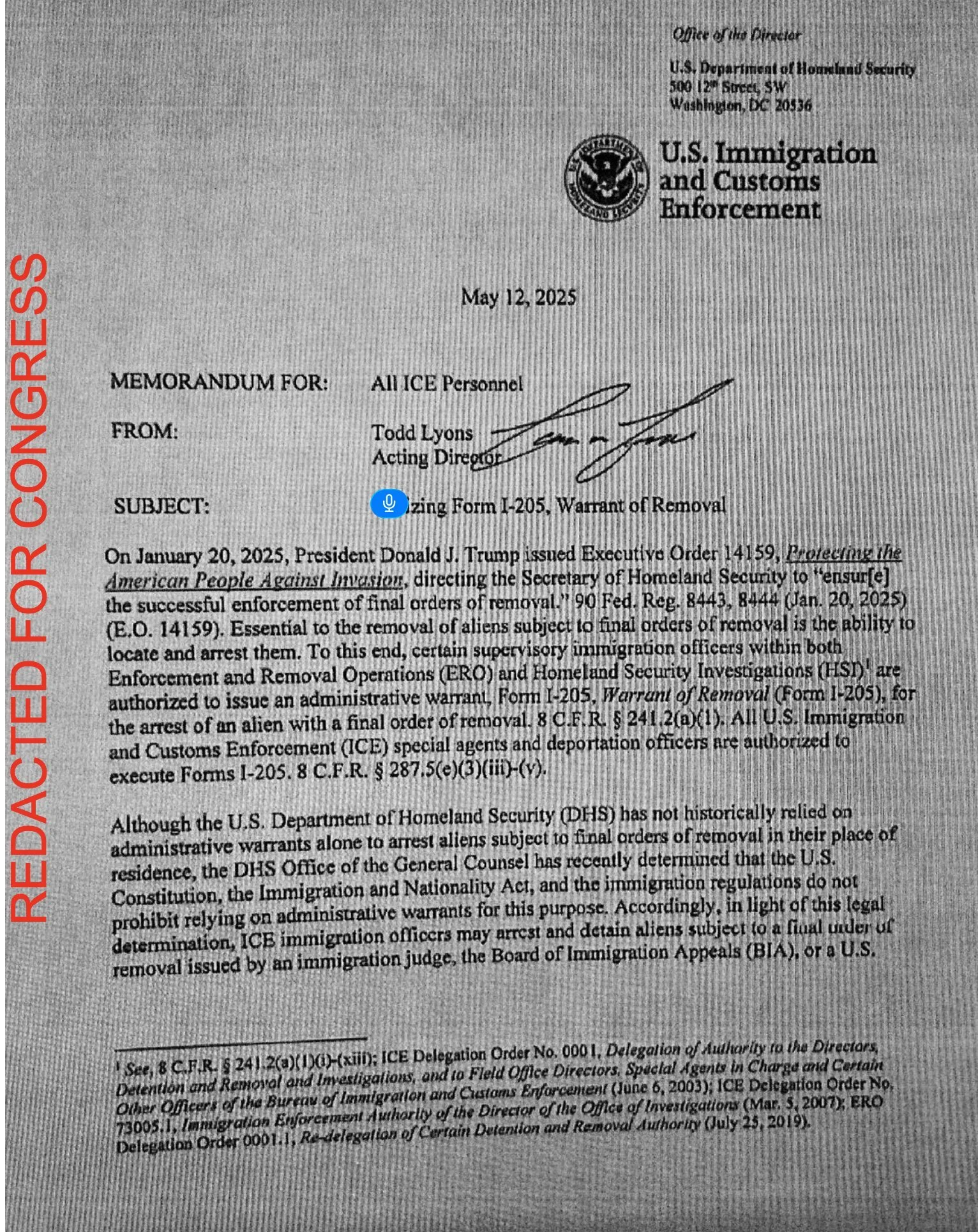
document 1
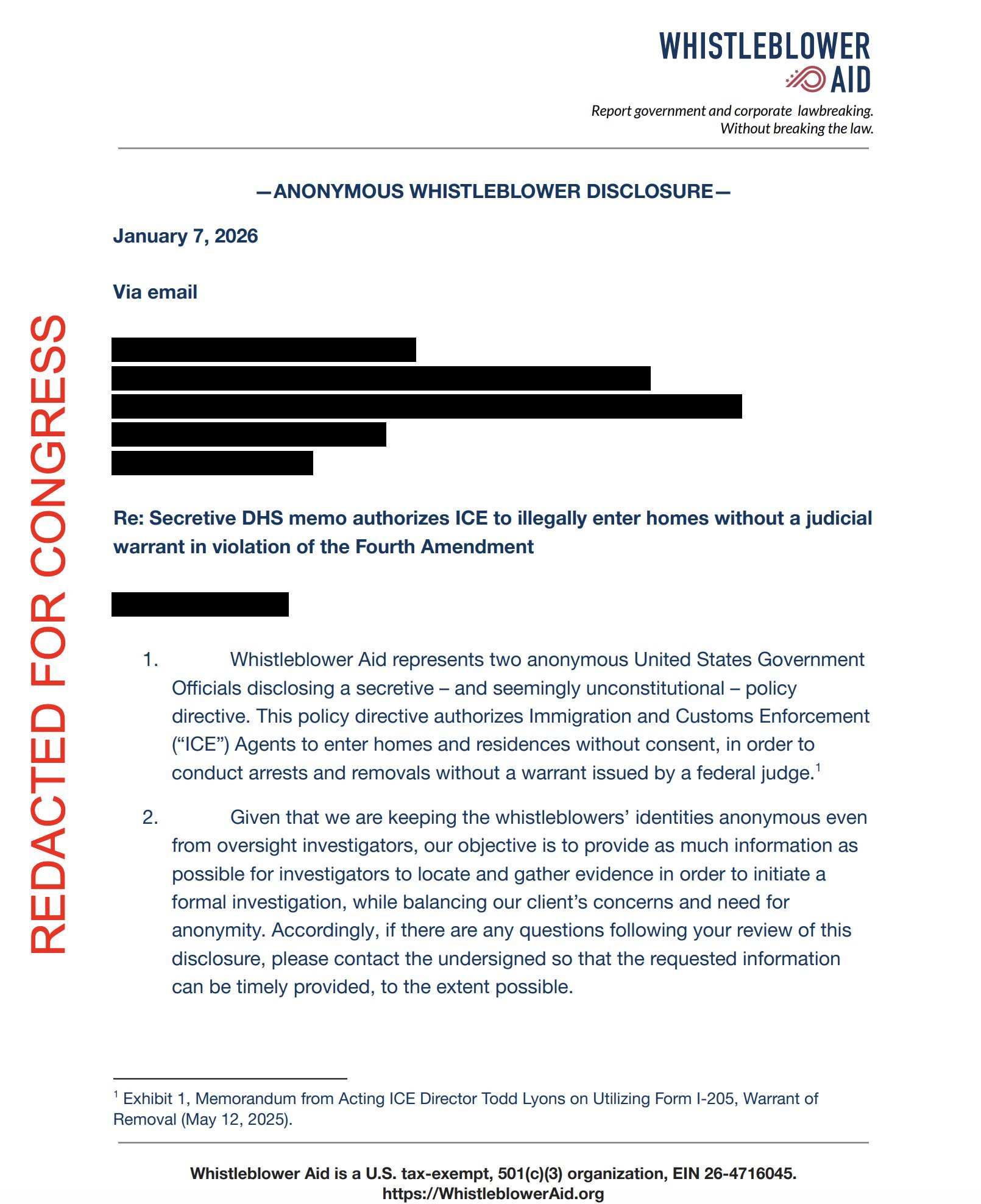
document 2
The first document, a May 12, 2025 Memorandum from acting ICE Director Todd Lyons to all personnel, provides the official blueprint. Titled “Form I-205, Warrant of Removal,” it cites President Donald J. Trump’s Executive Order 14159, “Protecting the American People Against Invasion,” as its impetus. The memo directs the agency to leverage existing regulations that authorize supervisory officers to issue—and agents to execute—an administrative Form I-205 warrant for individuals with final removal orders. Crucially, the memo acknowledges a historic shift: “DHS has not historically relied on administrative warrants alone to arrest aliens subject to final orders of removal in their place of residence.” It states this change is based on a recent determination by the DHS Office of the General Counsel that such actions are not prohibited by the Constitution or statute. This document transforms a theoretical authority into a field directive, explicitly reversing long-standing practice.
The second document, a whistleblower disclosure submitted January 7, 2026 by the organization Whistleblower Aid, provides the conscience and the condemnation. Representing two anonymous U.S. Government Officials, it labels the Lyons memo a “secretive – and seemingly unconstitutional – policy directive.” It states the policy “authorizes ICE Agents to enter homes and residences without consent… without a warrant issued by a federal judge.” These documents together form a complete picture: an official policy enacted in May 2025, followed nine months later by government insiders risking their careers to flag it as an illegal overreach. The whistleblowers’ stated goal is to provide investigators with a roadmap to evidence, balancing their need for anonymity with the urgency of exposure.
An administrative warrant like Form I-205 fails this basic test. It is not issued by a detached judicial officer upon a showing of probable cause; it is a document produced by the arresting agency itself. This, critics assert, transforms it from a protective check on government power into a self-serving tool of enforcement, gutting the essential reasonableness requirement for entering the most private of spaces—the home.
The Department of Homeland Security defends the policy, stating it applies only to individuals who have already received full due process and a final order of removal. However, this justification does not address the constitutional method of arrest, only its target. The principle, scholars note, is that the how is as important as the who; the Fourth Amendment’s protections of the home apply to everyone within U.S. borders, irrespective of citizenship status.
This explosive policy shift lands on a population still grieving and a nation freshly reminded of the lethal potential of escalated immigration enforcement. It comes on the heels of the January 7, 2026, killing of Renée Good, a 37-year-old American citizen, by ICE agent Jonathan Ross in Minneapolis. Good was shot during an encounter that began when ICE agents approached her vehicle. Official accounts claiming self-defense and that Good struck the agent have been fiercely contested by eyewitnesses, journalists, and Democratic lawmakers. The shooting triggered national protests, federal deployments of tear gas, and the resignation of more than a dozen federal prosecutors after the Justice Department declined a constitutional investigation. Minnesota’s political leadership, including Attorney General Keith Ellison, Governor Tim Walz, and Minneapolis Mayor Jacob Frey, have sued DHS to halt ICE activities and called for the agency’s removal from the city. The Good case has become a rallying point, embodying public fears about accountability, transparency, and the aggressive posture of federal immigration agents.
The leaked memo does not exist in a vacuum. It represents a deliberate operational hardening, set against a backdrop of profound local trauma and national division. Its implementation will almost certainly face swift and severe legal challenges focused on its constitutional infirmity. For communities across America, the directive sends a chilling message: the threshold of the home, once safeguarded by the judiciary, may now be crossed with a piece of paper authored by the very officers seeking entry. It tests a core American covenant—that a person’s home is their castle, not an extension of an administrative state.
As legal battles prepare to unfold, the public conscience is freshly seared by the memory of what can happen when enforcement is unleashed without adequate restraint and transparent oversight. The question now is whether the courts, and the nation, will uphold the founding principle that the right to be secure in one’s home is not a privilege, but a fundamental guarantee.
HOME | NATIONAL | HEALTH / LIFESTYLE | FINANCE | SPORTS | TECH | MUSIC / ENTERTAINMENT | OPINION